
An AI agent is software that takes an input, decides on a sequence of steps, uses tools or systems to act, and produces an outcome with limited human involvement. In a business context, that means handling a specific piece of work that currently consumes staff time: reading a document, assessing a request, updating a record or drafting a response.
The useful question is not whether the technology works. It is whether a specific process is bounded enough, repetitive enough and valuable enough for automation to be worth operating. Most failed agent projects pick the wrong process rather than the wrong model.
What an agent actually is, practically
It is a controlled loop around a language model with access to defined tools. The model interprets the input, decides what to do next, calls a tool such as a database lookup or a record creation, observes the result and continues until it reaches an outcome or an escalation point.
What makes it production software rather than a demonstration is everything around the loop: the permissions it runs with, the data it can reach, the validation applied to its output, the record of what it did, and what happens when it fails. Four components carry that:
- Model layer. The reasoning step, whether hosted by a provider or run inside your own environment.
- Tool layer. The defined actions the agent may take: read a record, create a case, send a notification, call an internal API.
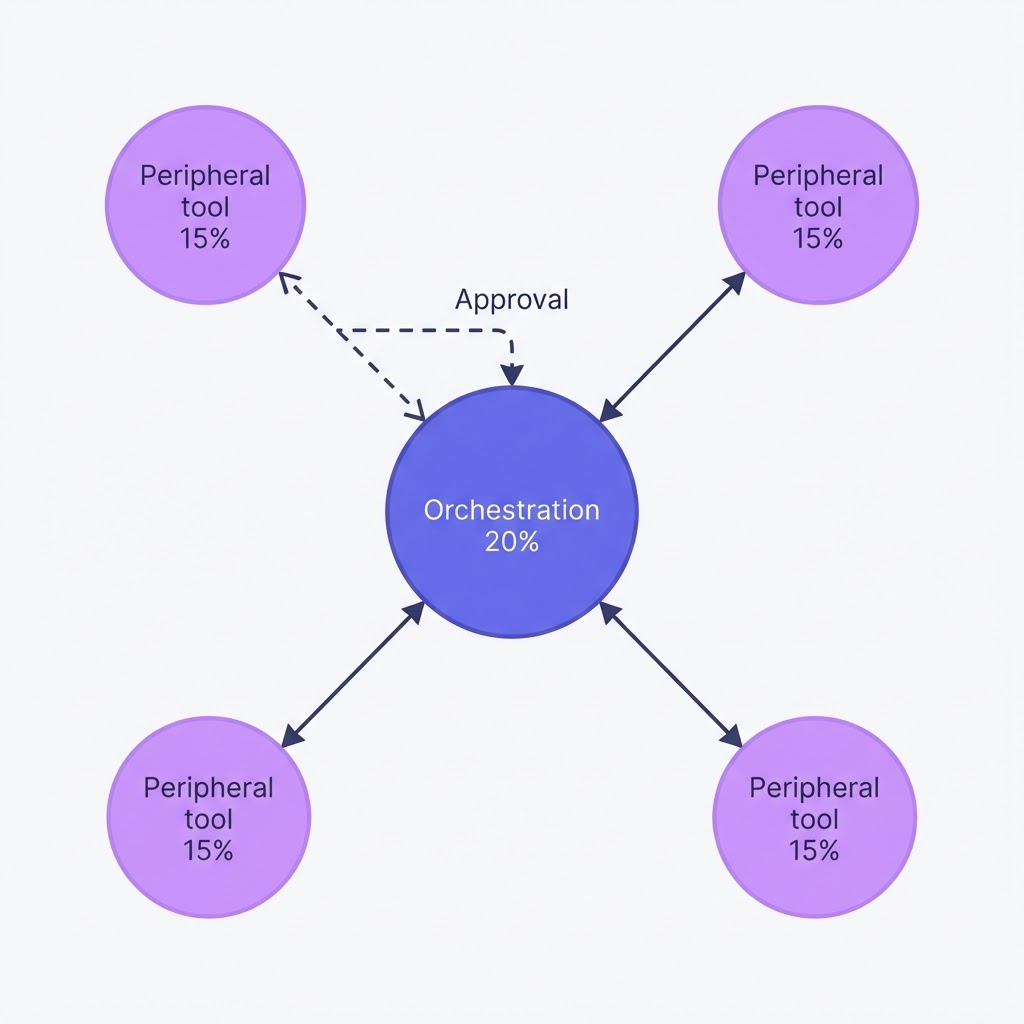
- Orchestration. The workflow that supplies context, sequences steps, applies limits and decides when to escalate.
- Guardrails and telemetry. Input and output validation, permission boundaries, full logging of prompts, tool calls and outcomes, plus cost and failure monitoring.
Without the last two, what you have is an experiment with a user interface. The architecture that makes agent to system communication repeatable is the subject of our guide to MCP and A2A in enterprise integration.
Where agents pay back
Automation is most productive where work is high volume, text or data heavy, and governed by rules that can be written down.
| Process | What the agent does | Systems required | Oversight level |
|---|---|---|---|
| Enquiry qualification | Classifies inbound enquiries, summarises them, routes with a suggested next action | CRM, email or form intake | Human sends the response |
| Document processing | Extracts fields from invoices, purchase orders and contracts, validates before posting | Finance or ERP system, storage | Exceptions reviewed |
| Support triage | Categorises requests, answers from approved knowledge, routes complex cases with history | Helpdesk, knowledge base | Sampled review |
| Internal knowledge retrieval | Answers policy and product questions with sources cited | Document store, identity provider | Self-serve with citations |
| Operational decision support | Recommends within defined parameters, such as pricing inside a band | Pricing engine, inventory data | Approval above threshold |
Where it usually does not pay back: low-volume work, processes with no consistent rules, decisions that carry commercial or legal accountability, and anything where the cost of an occasional wrong answer exceeds the value of the time saved.
Workflow automation versus a chat interface
The visible part of an AI project is often a chat window. The valuable part is usually the workflow behind it.
A well-designed implementation fits into the process the business already runs: a document arrives, the agent extracts and validates, a record is created, an exception is raised to a named person if confidence is low, and the outcome is logged. The user may never think of it as AI, which is the correct outcome for most operational work.
A chat interface is appropriate when the work is genuinely exploratory: analysts asking questions of data, staff searching policy, support agents looking for precedent. It is a poor fit for high-volume, rule-governed processing, where the interface should be the existing system and the agent should be invisible.
CRM and system integration
An agent that cannot reach your systems produces advice rather than work. Integration is therefore the substantive part of most projects: which systems it can read, which it can write to, under what identity, and with what limits.
Practical rules we apply: the agent runs as a service identity with the minimum permissions required; writes are validated against the same rules as human input; irreversible actions such as payments or deletions require explicit human approval; and every call to an external system is attributable in the audit trail.
Our API integration work for agent programmes concentrates on those boundaries, because an agent with broad database access is a security incident waiting for a trigger.
Sales and service operations
The most common commercial applications sit around the edges of a sales or service team rather than replacing it. Qualification, summarisation, drafting, follow-up scheduling and record hygiene. These tasks are repetitive, they consume senior time, and their output is easy to review.
A useful pattern is the agent producing a structured brief before a human conversation: who the customer is, what they have asked for, what is known from previous interactions, and what the recommended next step is. The person still makes the call, and the quality of the call improves.
In commerce, the same pattern is moving outward into the buying process, which we cover in agentic commerce.
Human oversight and thresholds
Define explicitly where the agent decides and where a person does. Common thresholds: value of transaction, confidence of extraction, presence of an unfamiliar pattern, and any case touching a regulated process.
Oversight is only meaningful if the reviewer can see the input, the output and the reasoning. A review step that presents a conclusion with no trace back to the source is not oversight, it is a rubber stamp with extra steps, and it trains the reviewer to approve.
Data protection and boundaries
Decide before building: which data the agent may access, whether that data leaves your infrastructure to reach a model provider, what is retained and for how long, and who inside the business can inspect the logs.
Where a requirement can be met without sending sensitive data to an external provider, design it that way. Where an external model is necessary, use a provider arrangement with appropriate contractual terms, and avoid placing regulated data in prompts unless it is necessary for the task and permitted. Disclose automated interaction to customers, and always provide a route to a person.
Regulatory expectations are also moving. Organisations serving EU customers should take account of the transparency obligations introduced by the EU AI Act, and in the UAE the processing of personal data falls under Federal Decree-Law No. 45 of 2021, with separate regimes in the DIFC and ADGM. For most agent projects this changes documentation and disclosure rather than whether the project is viable, but it should be considered at design stage rather than at launch.
Cost structure
Cost has four components: the integration and build work, the model or provider usage per run, the review time your team spends, and the ongoing maintenance of prompts, versions and tests.
Build and integration usually dominate the first year. Usage cost scales with volume and is the component most worth monitoring, because a poorly scoped agent can call a model several times per case without adding value. Review time is the cost most often omitted from business cases, and it is the one that determines whether the automation actually saves anything. Maintenance is small but permanent: prompts, model versions, evaluation sets and integration changes all need an owner.
Judging return on investment
The honest test is whether the same work is done in less total time, at equal or better quality, with a defensible record. Anything else is a demonstration with a budget.
An illustrative model, with all figures assumed:
| Item | Before automation | After automation |
|---|---|---|
| Cases per month | 4,000 | 4,000 |
| Handling time per case | 6 minutes | 6 minutes on the 20% escalated |
| Staff hours per month | 400 | 80 handling plus 53 reviewing |
| Model usage | None | 4,000 cases at AED 3 |
| Monthly cost at AED 90 per hour | AED 36,000 | AED 24,000 |
The assumptions are deliberate and should be replaced with your own measurements. The point of the table is that the saving comes from reduced handling, not from model usage, and that review time is a real line item rather than a rounding error.
Implementation roadmap
| Phase | Objective | Complete when |
|---|---|---|
| 1. Process selection | Choose one bounded, repetitive process with measurable cost | Baseline volume, time and error rate recorded |
| 2. Design | Define tools, permissions, thresholds and escalation routes | Architecture and data boundaries agreed |
| 3. Pilot | Narrow version on real data with human review | Accuracy measured against historical cases |
| 4. Integration | Connect write actions with validation and audit logging | Agent operates inside the real workflow |
| 5. Scale | Extend coverage, monitor cost and drift | Cost per case stable, escalation rate understood |
Common mistakes
- Automating a process nobody has documented.
- No baseline, so improvement cannot be demonstrated.
- Granting broad permissions because scoping them takes time.
- No evaluation set, so quality is judged on anecdotes.
- No monitoring of cost or failure rate after launch.
- Automating decisions that should stay with an accountable person.
- Reviewing every output without recording why it was approved, which produces cost with no learning.
Frequently asked questions
What is the difference between an AI agent and a chatbot?
A chatbot responds with text. An agent takes actions through tools, in sequence, until it reaches an outcome. The difference is the tool layer and the permissions around it, not the interface.
Do AI agents replace staff?
In the processes that work well, they remove the repetitive portion of a role rather than the role. Qualification, extraction, drafting and routing are the tasks that move; judgement, accountability and customer relationships stay with people.
How much does an AI agent cost to build?
It depends on the number of systems integrated, the strictness of the oversight model and the quality of the process documentation. A single-process agent connected to one system is a different proposition from a multi-system workflow with approvals, and we scope against the specific process.
How do we stop an agent doing something wrong?
Least-privilege service identities, validation of writes against the same rules as human input, human approval for irreversible actions, and an evaluation set drawn from real historical cases including the difficult ones. Logging every step makes investigation possible after the fact.
Can agents work with our existing ERP or CRM?
Yes, and that integration is usually the largest part of the work. Systems without a usable API require an intermediate service or database-level integration with tighter controls.
How do we measure success?
Cost per case before and after, including review time, alongside quality and escalation rate. If the same work is not done in less total time at equal quality, the automation has not paid back.
Key takeaways
Agents pay back on bounded, repetitive, rule-governed work with clear system integration and human review. Scope one process, record a baseline, integrate with minimum permissions, instrument cost and quality, and only then extend to the next workflow.
Next step: our AI agent development page sets out what we build and how delivery runs, and AI and automation covers the wider programme. To test whether a specific process is worth automating, start your AI project and we will say plainly whether an agent is the right answer and what it would take to operate one.